





Relaxing Music for Dogs: A Practical, Safe, and Evidence-Based Guide
What is Canine Music Therapy and When to Use It?
Music therapy for dogs is the intentional use of sound (rhythm, melody, and harmony) to promote communication, learning, and relaxation. I use it as a complementary tool when I want to lower a dog's arousal and create a gentler environment: moments of separation anxiety, veterinary visits, post-operative recovery, nights with fireworks, or very hot days when encouraging rest is beneficial.
It works best when the dog's basic needs (walks, water, food) are already met, and the music becomes a signal for "time to rest," rather than a last-minute patch.
- Noise-sensitive dogs (masks random outdoor sounds).
- Dogs that need to recondition the home as a safe space.
- Shelters/rescues with high-excitement environments.
Serious issues (advanced separation anxiety, severe phobias). Here, music provides support, but you need a behavioral plan.
Real Benefits: Anxiety, Pain, Noise Phobias, and More
- Stress and Anxiety: The right music reduces excitability and encourages resting behaviors.
- Pain Relief (Indirect): If stress decreases, the discomfort threshold improves; useful in post-operative care.
- Phobias/Auditory Hypersensitivity: Acts as an acoustic screen to soften environmental contrasts (door slams, fireworks).
- High-Stress Environments: In shelters, it helps reduce barking and improves group harmony.
- Veterinary Clinics: Creates a better predisposition for handling and examination.
What Music to Play: Classical, Soft Rock, Reggae, Audiobooks, and Playlists
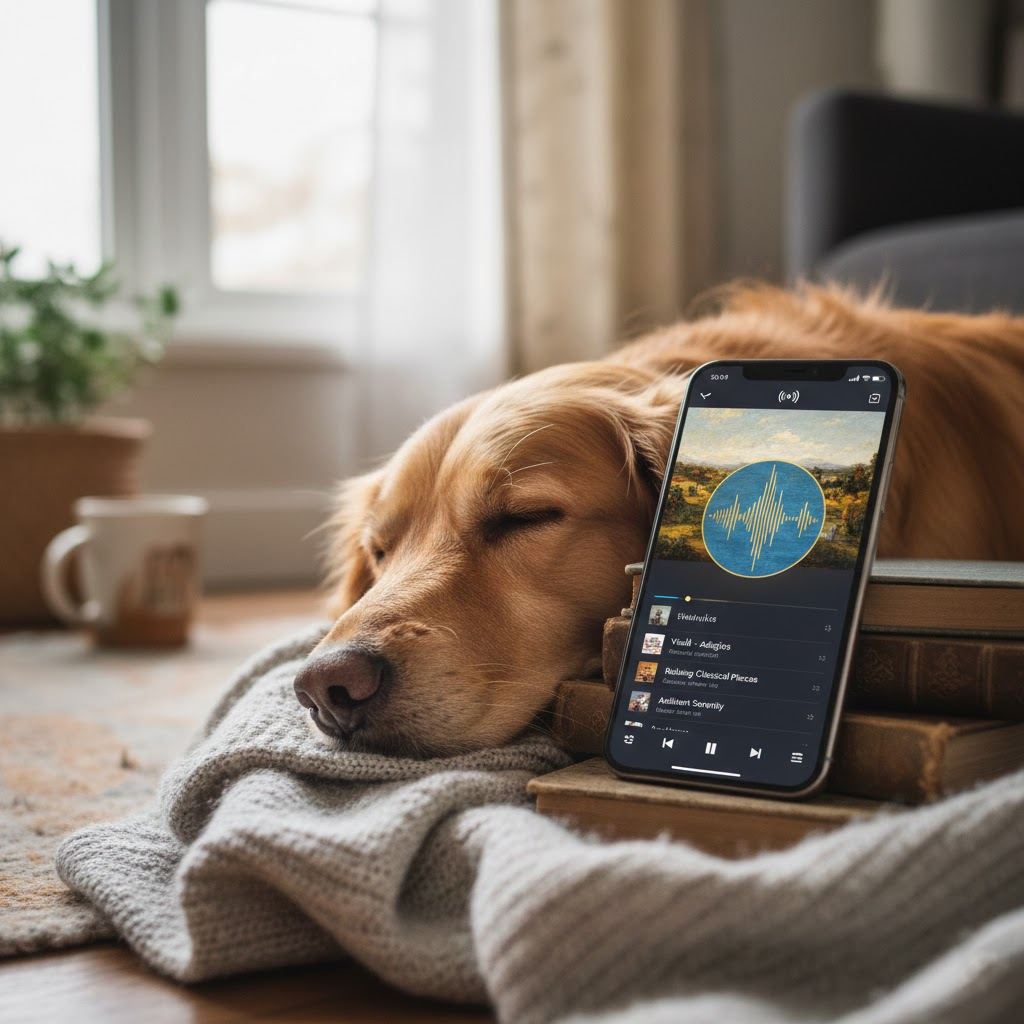
Options that usually work: Soft classical (e.g., Vivaldi, adagios without sudden changes), Soft rock / Reggae at low volume, Ambient / Chill, Audiobooks with calm narration, and music specifically designed for dogs.
Avoid or use with caution: Heavy metal and tracks with volume spikes. Also, songs that the dog associates with negative experiences.
What music calms dogs down?
Music that maintains a constant tempo, smooth transitions, and warm tones. Slow classical, ambient, and calm narration are usually good first trials.
What music helps dogs relax?
Anything that facilitates regular breathing and a resting posture: avoid crescendos and very heavy bass; look for 5–10 minute pieces linked without breaks.
Technical Parameters: Volume (60–70 dB), BPM, and Optimal Duration
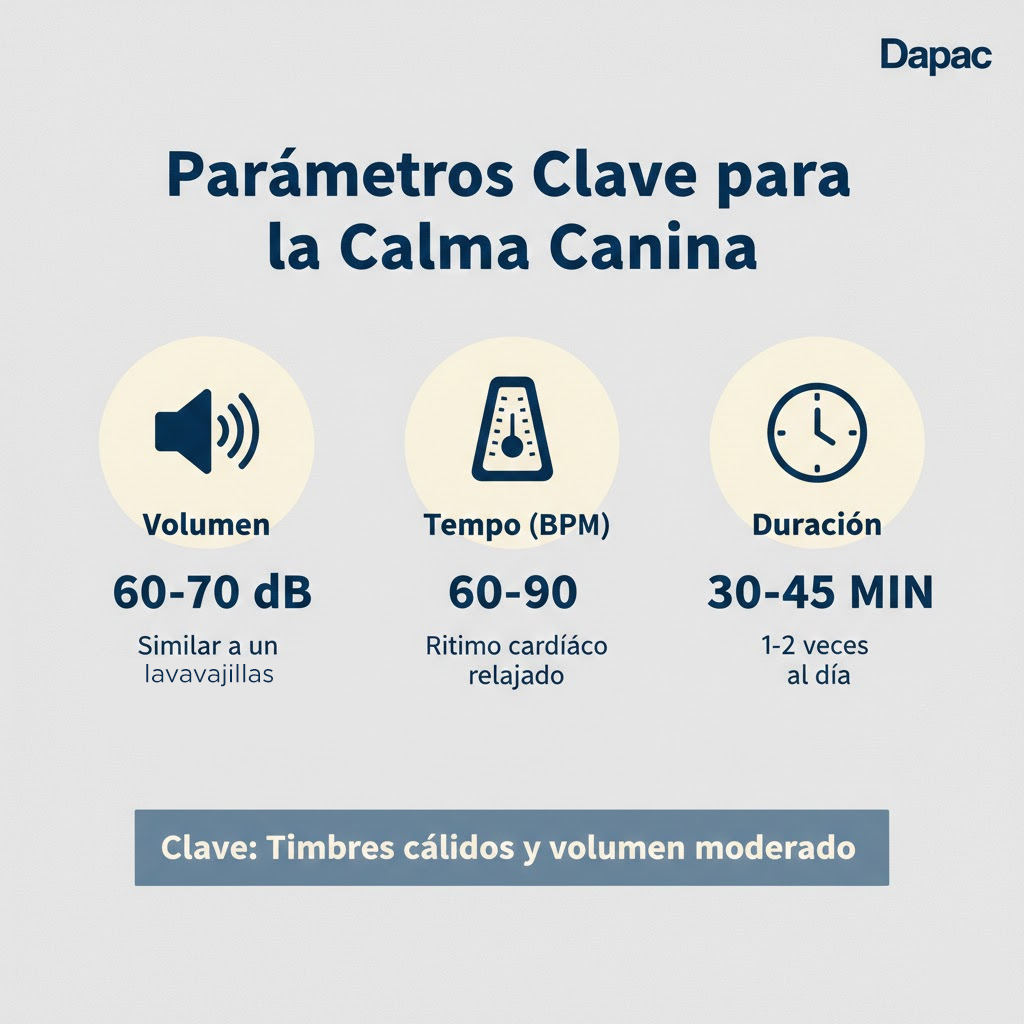
- Volume: Keep it between 60 and 70 dB (similar to a dishwasher).
- BPM (Tempo): Aim for 60–90 BPM for relaxation and <110 BPM if you need to mask noise without causing excitement.
- Duration: 30–45 minutes, 1–2 times a day to avoid sensory fatigue.
Quick Measurement: Use any sound meter app on your phone to check that you don't exceed 70 dB at 1–2 meters from the speaker. Best results usually come with 30–45 min sessions at 60–70 dB; anything louder may bother them.
What "frequency" calms dogs?
Rather than a fixed frequency, think of soft timbres and an absence of sharp highs. Remember that their hearing range is wider than ours; therefore, moderate volume is key.
Routines by Objective: Sleeping, Fireworks/Noise, Home Alone, Vet Visit
Better Sleep: 1) Walk and water → 2) Dim lights → 3) Classical/Ambient at 60–70 dB → 4) 30–40 min and fade-out. Tip: Always use the same list.
Fireworks/Noise: Prepare an acoustic shelter. Start stable music 10–15 min before the noise begins. Maintain a constant tempo. For fireworks, it helps me to talk little and offer long licking tasks (Lick mat) while the music plays.
Home Alone: Predictive signal: 5 min of an audiobook or playlist only when they are actually left alone. Start with gradual absences.
Vet Visit / Post-Op: 15 min prior in the car. At home, short and frequent sessions for the first 3–5 days.
How to calm anxiety quickly with music?
Breathe first (your calm is contagious), dim the lights, 60–70 dB, an 8–10 min track, and a licking or quiet sniffing task. If they don't settle in 10–15 min, change the genre or stop and try a different strategy.
Step-by-Step to Start Today (with Acceptance/Rejection Signals)
- Choose 3 lists: soft classical, ambient, audiobook.
- Set volume to 60–70 dB, speaker 1–2 m from the dog.
- A/B Testing: 10 min each on different days and observe.
- Measure signals: Lying down by your side, slow blinking, sighing → good. Tense panting, fleeing, ears pinned back → change it.
- Create a routine: same list for the same objective.
If the dog moves away from the speaker, that reaction is a clear clue: either the volume is too high or they don't like that specific sound.
Common Mistakes: Negative Associations, High Volume, and Heavy Metal
- Using the same track during panic moments: the dog will associate it with fear.
- Turning up the volume to "drown everything out": this creates more stress.
- Choosing lists with abrupt peaks or cuts.
- Expecting music to replace behavioral work.
Useful Resources: Long Playlists and How to Choose Them
8–9 hour playlists for "dogs home alone" (without ads). Slow classical lists. Audiobooks with stable narration. Create favorites by objective: "Sleep," "Mask Noise," "Solitude," "Car/Clinic."
Quick Table: Genre/Recommended Use/BPM/dB
| Objective | Recommended Genre | Approx. BPM | Recommended dB | Notes |
|---|---|---|---|---|
| Sleep/Nap | Slow Classical / Ambient | 60–80 | 60–65 | No heavy percussion |
| Masking Fireworks | Continuous Ambient / Soft Rock | 80–100 | 65–70 | Avoid long silences |
| Home Alone | Audiobook / Soft Classical | 60–90 | 60–65 | Real predictive signal |
7-Day Plan to Establish the Routine
Day 1–2: A/B Testing (10 min) with 3 options. Record signals (sighs, staying lying down).
Day 3–4: Choose the favorite and do 2 sessions/day of 20–30 min.
Day 5: Increase to 30–45 min during the main objective (e.g., nap time).
Day 6: Introduce the secondary objective (staying alone for 3–5 min).
Day 7: Consolidate: same list for the same objective; add a final fade-out.
FAQs
What music calms dogs? Slow classical, ambient, and soft rock/reggae.
What "frequency" calms dogs? Don't look for a magic number: prioritize warm timbres and a volume of 60–70 dB.
How can I calm my dog's anxiety? Quiet environment, bathroom break, stable music, licking tasks, and predictable routines.
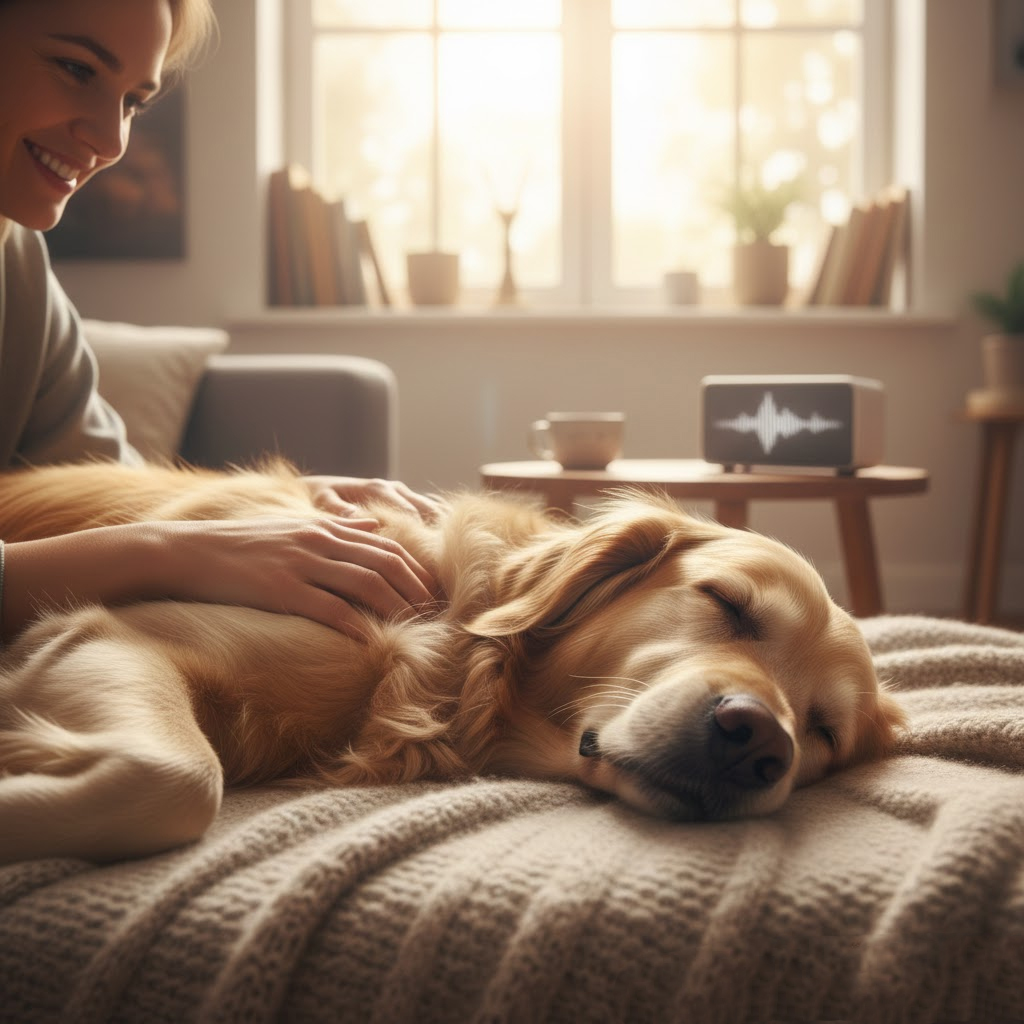
Where to massage to relax them? The chest and shoulder area with light pressure. If they seem uncomfortable, stop.
What is the 3-3-3 rule for anxiety (adoptions)? 3 days to decompress, 3 weeks to learn routines, 3 months to feel at home. Music helps during the decompression phase.
How to calm anxiety quickly? Dim lights, 60–70 dB, stable track, and a calm task (licking/sniffing).
What techniques besides music? Olfactory enrichment, moderate exercise, calmness training, and licking toys.
What are the "3 Cs" of canine calm? Consistency (routine), Context (controlled environment), and Control (of volume/timing: 60–70 dB; 30–45 min).
Relaxing music for dogs works when treated as a strategic tool: choosing the genre wisely, monitoring volume and duration, and integrating it into coherent routines. In my experience, 30–45 minute sessions at 60–70 dB, with stable lists and no peaks, make a real difference. And remember: if the dog moves away or becomes restless, they are telling you clearly: change the track or lower the volume. Music adds value, but it does not replace a behavioral plan.
Leave a Reply Cancel Reply