





Can dogs eat apples? Benefits, risks and safe amounts
Yes, dogs can eat apples. In fact, properly prepared, they can be a quite interesting snack to break the routine of other treats. However, here is the important nuance: you can't just give it to them any old way. Apples are only a safe option when offered in appropriate pieces, well-washed, and, above all, without seeds or the core.
I mention this clearly because it is the part most often overlooked. Many people think that since it's fruit, anything goes. And no. In my case, when I reviewed the correct way to offer it, what struck me most was that the real problem wasn't the pulp, but the seeds. That detail completely changes the recommendation: apples can fit into a dog's diet, but always with prior preparation and in moderation.
Furthermore, it shouldn't be seen as a staple food or something to give every day. It is an extra. A supplement. An occasional treat that can provide variety, hydration, and some nutrients, but does not replace a balanced diet. That is the key to not overdoing it or turning something healthy into a bad idea.
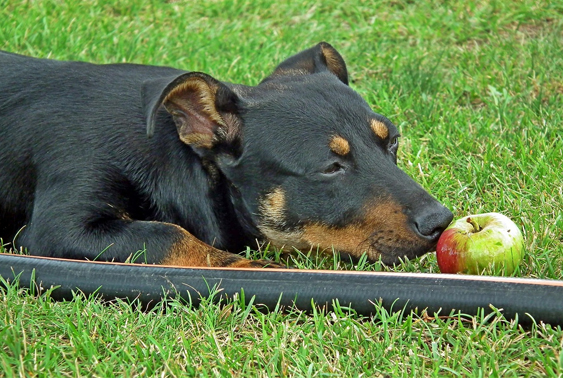
Yes, dogs can eat apples, but only in this way
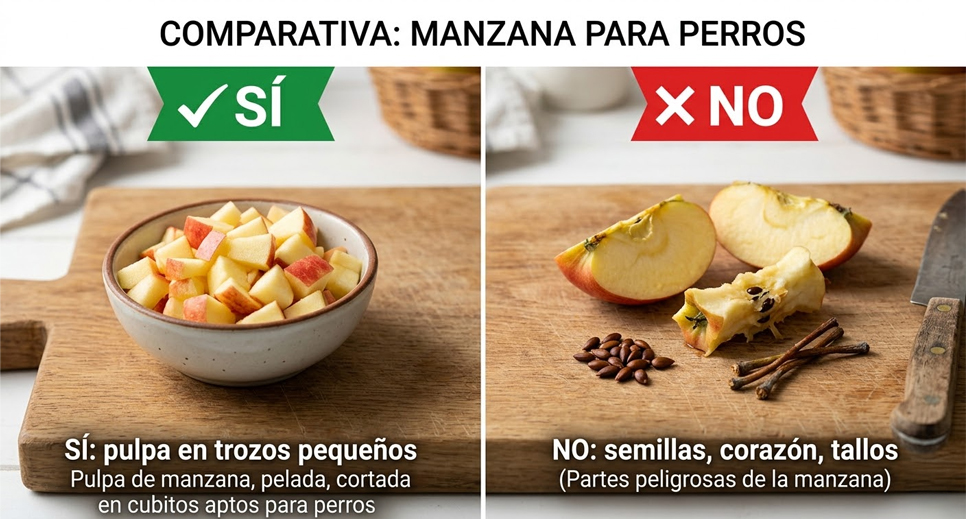
The safe part of the apple is the pulp. This is the area that can normally be offered to a dog in small portions. Ideally, wash it well, cut it into manageable pieces, and adapt it to the size of the animal to avoid choking, especially in small dogs or those very anxious with food.
The most prudent way to give it is simple: small pieces, without additives, and as an occasional treat. No sugar, no syrups, no “human” recipes disguised as a healthy snack. The simpler, the better.
Which part of the apple can they eat?
The pulp is the part that is usually used. It can also be given with the skin in some cases, provided it is well-washed and the dog tolerates it without digestive upset. Even so, if the animal has a sensitive stomach, starting with a small amount and observing how they feel is the most sensible approach.
Apples can fit well as a natural treat because they have a high water content. For dogs that need light snacks, this characteristic can be useful. In fact, one of the most valuable points mentioned is precisely that: its ability to provide hydration and serve as a lighter option, something especially interesting for dogs prone to being overweight.
What parts you must always remove: seeds, core, and stem
There are no half measures here: the seeds and the core are always removed. This is not an optional recommendation or an exaggerated whim. It is the basic safety rule. In your experience, this was very clear, and it is worth insisting on because it is the most important piece of information in the entire article.
The seeds contain toxic compounds, and it is not worth taking that risk. Additionally, the core is harder, less digestible, and can cause problems if the dog swallows it without chewing. So, to summarize it in a practical sentence: if you are going to give an apple, stick only to the clean, safe, and easy-to-eat part.
What effects do apples have on dogs?
When given correctly, apples can have positive effects. We are not talking about a miracle fruit, but a food with interesting properties within a varied diet. The good thing is that it combines several advantages at once: water, fiber, vitamins, and minerals in a very easy-to-offer presentation.
Benefits of apples: hydration, vitamins, and minerals
One of the most obvious benefits is its water content. This makes it a refreshing fruit and useful as an occasional treat, especially in hot weather or for dogs that enjoy juicy textures. In your case, you also pointed out that it can be an interesting option for overweight dogs or those with certain kidney problems, precisely because of its lighter and hydrating profile.
It also stands out for its contribution of vitamins C and A, carotenoids, and folic acid. Added to this are minerals such as potassium, phosphorus, magnesium, and calcium. All of this does not make the apple a substitute for main food, but a supplement with nutritional value beyond a simple whim.
Another point that I find especially useful is its possible contribution to the appearance of the skin and coat. When a snack provides something more than empty calories, it starts to make sense to include it every now and then. And here, the apple plays its cards well.
When it can be a useful snack for overweight dogs
Apples can be a better idea than other fattier or highly processed treats, especially if used wisely. For a dog that needs to control its weight, swapping part of the conventional snacks for small portions of fruit can make sense. However, “healthier” does not mean “all you can eat.”
This is important because, although it is fruit, apples contain natural sugars. Therefore, it should be used in moderation. I like to put it this way: apples work better as an occasional treat than as an automatic daily habit. This approach helps to take advantage of its benefits without exaggerating.
Risks of apples for dogs
If someone only takes away the “yes, they can eat it” part, they only get half the answer. The other half lies in the risks. And no, they are not to be dramatized, but to ensure things are done right.
Why seeds are dangerous
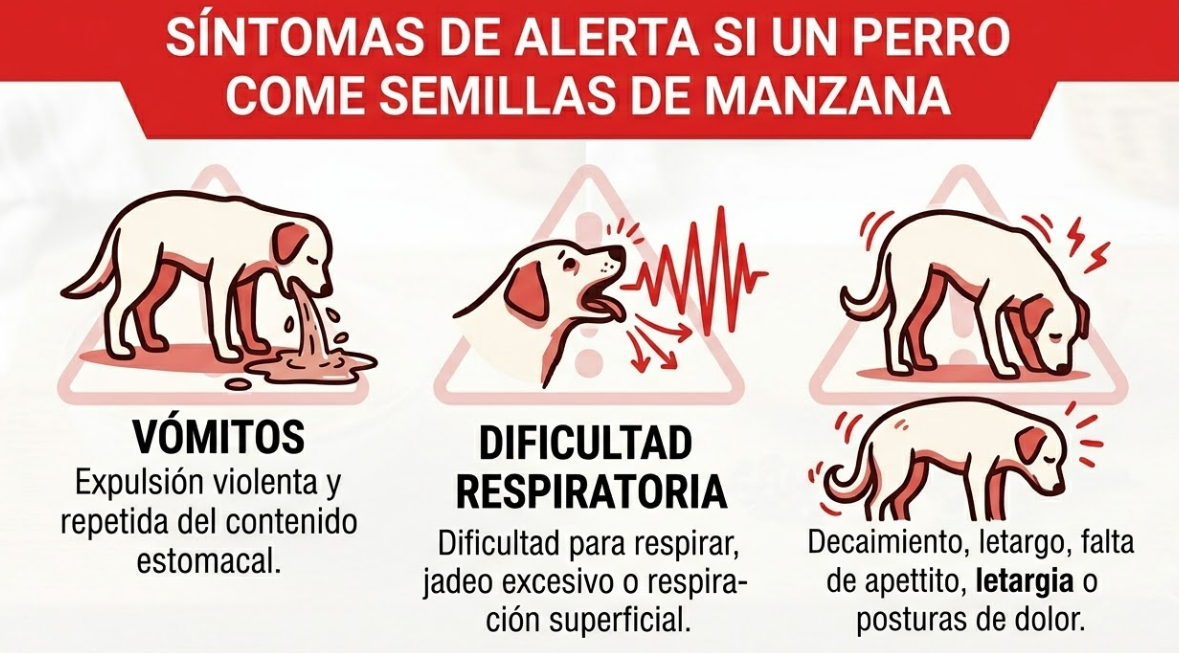
This is the main red flag. Seeds contain toxic substances and should not be part of the dog's portion under any circumstances. In your experience, you explained it very well: the risk can range from vomiting to respiratory difficulty and, in severe cases, serious complications. This warning deserves to be highly visible because it is exactly the kind of practical detail that differentiates a useful article from a superficial one.
The good news is that it is an easy risk to avoid. we are not talking about something complex, but a basic preparation gesture: removing seeds and core before serving the fruit. Once that is done, the scenario changes significantly.
What happens if a dog eats too many apples?
Here the problem is usually less dramatic than with the seeds, but it still exists. An excess of apple can cause digestive upset, diarrhea, or loose stools. Additionally, due to its sugar content, it is not advisable to offer large quantities or turn it into an uncontrolled daily habit.
That's why moderation rules. The typical mistake isn't giving one piece, but thinking that because they liked it, it can be repeated without limit. And with dogs, that happens a lot: if they love something, they will ask for it as if it were compatible with having the same for breakfast, lunch, and dinner. That's where the human has to step in.
How much apple can I give my dog?
The amount depends mainly on the size of the dog and the frequency with which you offer it. Your weekly reference here is very useful because it brings the theory down to something applicable.
Recommended amount for small dogs: In small dogs, the prudent recommendation is to offer occasional pieces, with a maximum guideline of one apple per week, always spread out and not all at once. In practice, many times you won't even need to reach that figure. A few well-measured pieces are usually plenty.
Recommended amount for medium dogs: In medium dogs, a reasonable reference is one apple per week. Again, better distributed in several small servings than offered all at once. This reduces the digestive load and allows for better monitoring of tolerance.
Recommended amount for large dogs: In large dogs, the range can go up to one or two apples per week, depending on their size, activity, and tolerance. But even here, I would keep the same mental rule: an occasional treat, not an automatic habit.
Quick Guidance Table
| Dog Size | Guideline Amount | Frequency |
|---|---|---|
| Small | Small pieces, up to 1 apple/week | Occasional |
| Medium | Up to 1 apple/week | Occasional |
| Large | 1 to 2 apples/week | Occasional |
This table does not replace veterinary criteria if the dog has a pathology, but it serves as a realistic starting point so as not to improvise.
How to safely give an apple to a dog
The best way to get it right is to choose simple preparations. No sugar, no weird mixes, and no ingredients designed for humans.
Fresh and chopped apple: It is the easiest and probably most practical option. Wash, remove seeds and core, and cut into small pieces. There isn't much science to it, and the risk drops significantly.
Dehydrated apple: It can also work as a snack, provided it is a simple version without additives. Here it is worth checking carefully that it does not contain extra sugars or strange ingredients. As a general rule, the cleaner the composition, the better.
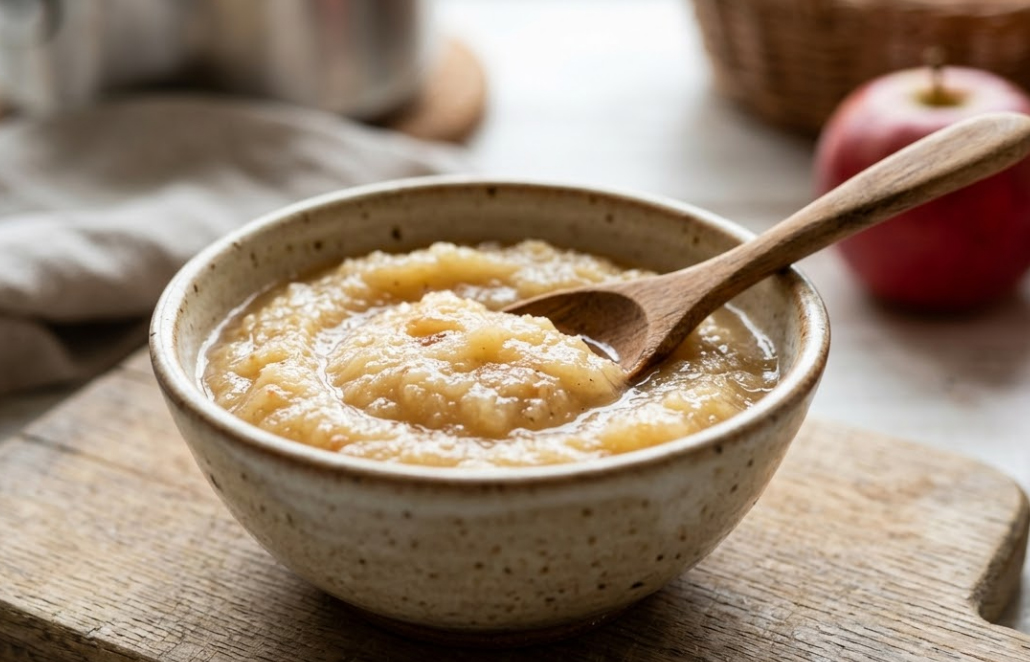
Homemade apple puree: Another interesting option is to cook and mash it into a homemade puree, without sugar or other ingredients. This can be good for older or sensitive dogs that tolerate soft textures better.
Mixed with their usual food: Adding a few pieces or a tablespoon of puree to their food can provide variety. I find this a particularly useful idea for those looking to introduce it little by little and observe tolerance. Sometimes, small mixed amounts work better than giving a separate treat.
What do I do if my dog ate an apple?
The first thing is not to panic. There is a big difference between eating a piece of pulp and swallowing seeds or a large quantity.
When nothing happens and you just need to watch: If they have eaten only pulp, without seeds or the core, and in small amounts, usually nothing serious happens. In that case, it is reasonable to observe for a few hours and monitor digestion, appetite, and behavior.
When to go to the vet: If they have ingested seeds, a large quantity, or start with vomiting, difficulty breathing, or clear discomfort, it is time to consult with the veterinarian as soon as possible. Here it is better not to improvise or wait “to see if it passes” when there is potential exposure to something toxic.
What fruits should not be given to a dog?
Rather than memorizing long lists, I would stick with this idea: you should never assume a fruit is valid just because it seems healthy to us humans. In canine nutrition, details matter: seeds, pits, sugar, skin, quantity, and individual tolerance change the answer.
In the specific case of the apple, the conclusion is favorable because the pulp can be given, but always avoiding the conflicting parts. That distinction is what makes the difference between a safe treat and an avoidable mistake.
FAQS - Frequently asked questions about apples as food for dogs.
Can dogs eat apples?
Yes, dogs can eat apples as long as you give them without seeds, without the core, and in small pieces. The pulp is the safe part and can be offered as an occasional treat.
What benefits do apples have for dogs?
Apples can provide hydration, fiber, vitamins such as C and A, and minerals such as potassium, phosphorus, and magnesium. Furthermore, they are usually a light snack and easy to portion.
What part of the apple can a dog eat?
A dog can eat the pulp of the apple. The skin can also be given if it is well-washed and sits well with them, but seeds, core, and stem must always be removed.
Can dogs eat apple seeds?
No. Apple seeds are not safe for dogs and must always be removed before offering the fruit.
What happens if my dog eats apple seeds?
If your dog has ingested seeds, it is advisable to monitor them closely and consult with the veterinarian if they have eaten several or show symptoms such as vomiting, difficulty breathing, or evident discomfort.
How much apple can I give my dog?
It depends on their size. As a general guide, small dogs can have occasional pieces, medium ones up to one apple per week, and large ones between one and two, always spread out and in moderation.
How often can an apple be given to a dog?
It is recommended to give it as an occasional snack, not daily. The important thing is that it remains a supplement and not a main part of their diet.
Can puppies eat apples?
Yes, but in very small quantities, well-chopped, and observing how it sits with them. With puppies, it's best to be even more cautious with texture and quantity.
Can dogs eat apples with the skin?
Yes, they can eat it with the skin if it is well-washed. Even so, if your dog has a sensitive stomach, it is better to start with a small amount to check tolerance.
Is a red or green apple better for dogs?
Both can be valid. The important thing is not so much the type of apple as the way it is prepared: without seeds, without the core, and in appropriate portions.
Is apple good for overweight dogs?
It can be an interesting option as an occasional treat because it has a lot of water and is lighter than other snacks. Even so, it still has natural sugar, so it shouldn't be overused.
How is an apple safely given to a dog?
The best way is to wash it, remove seeds and core, and offer it in small pieces. It can also be given dehydrated without sugar or in homemade puree without additives.
Can a dog eat apple sauce?
Yes, provided it is homemade or natural sauce, without sugar, sweeteners, or added ingredients. It should be given in small amounts.
What do I do if my dog ate a whole apple?
If they have only eaten pulp, usually just observing them will suffice. If they have also swallowed seeds or the core, or if you notice digestive or respiratory symptoms, the prudent thing is to call the veterinarian.
Can an apple make a dog feel sick?
Yes, if they eat too much or if it isn't properly prepared. In some cases, it can cause diarrhea, digestive upset, or gas.
Leave a Reply Cancel Reply