




What is the primordial pouch in cats?
Many caregivers experience the same thing the first time they notice it: they see a sort of "little belly" hanging from the lower abdomen and think the cat has gained weight. However, in many cases, it is not obesity, but the primordial pouch—a completely normal structure in feline anatomy. The three competitors we analyzed agree on this basis: it is a fold of skin and tissue on the lower belly that should not be automatically confused with a weight problem.
The true interest behind this search is not just knowing "what it is," but answering a much more practical question: whether that hanging area is normal or if one should be concerned. Therefore, the best approach is not to give a quick definition and move on, but to explain what it is for, when it is most visible, how to distinguish it from overweight, and in which cases it actually warrants a veterinary check-up. AniCura and Rover already cover part of this journey, but there is still room for a more visual explanation that is closer to the user's real language.
It is also common for its appearance to be linked to neutering, or for people to think that only some cats have it. This confusion exists because the primordial pouch can become more evident with age, with certain movements, or in breeds where it is more noticeable. Vitakraft presents it as a structure located in the lower belly with functions linked to energy, movement, and protection, while AniCura and Rover further reinforce the difference compared to obesity and the importance of observing the cat's body as a whole.
What is the primordial pouch in cats?
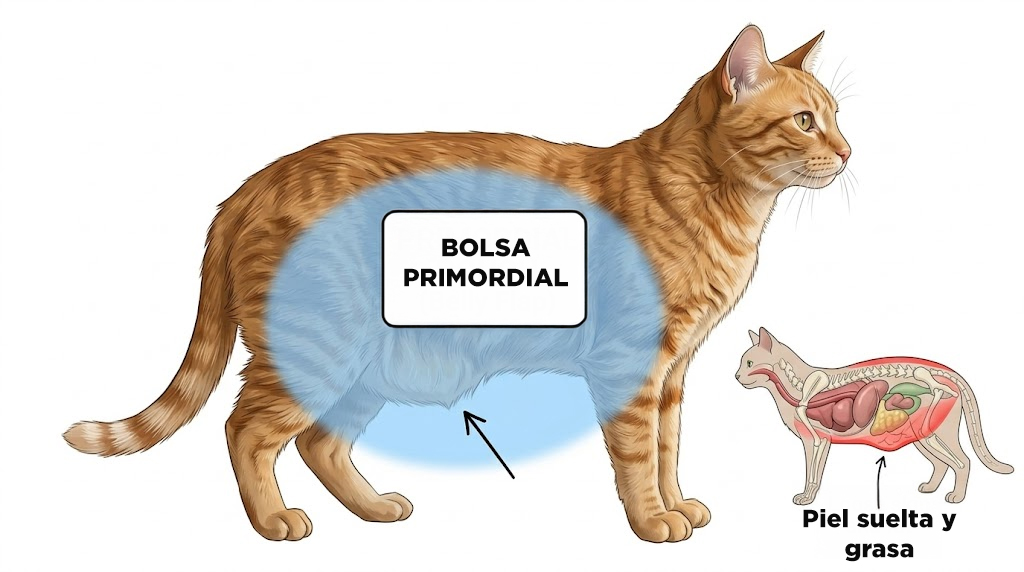
The primordial pouch is a fold of skin and fatty tissue located at the lowest part of the cat's abdomen, near the hind legs. It is not a tumor, it is not a hernia by default, and it does not mean on its own that the animal is overweight. AniCura describes it as a pouch of skin and fat located in the most sloped area of the abdomen, while Rover presents it as a belly flap made of excess skin and tissue.
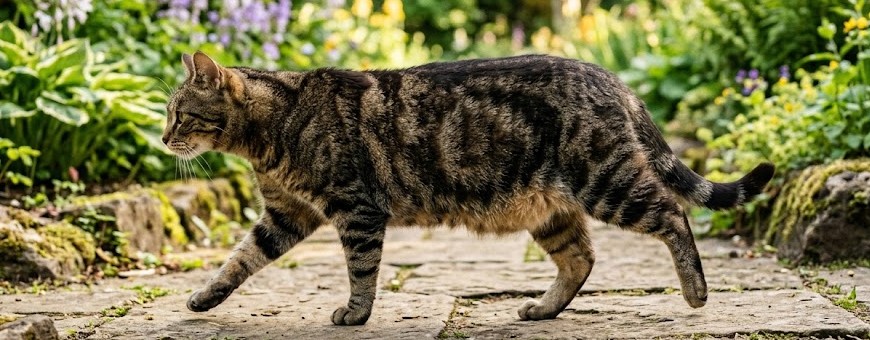
Visually, it is usually best appreciated when the cat walks, trots, or changes direction. Many caregivers notice that this area sways slightly from side to side, and precisely that movement is one of the clues that helps recognize it. It does not behave like the accumulated fat of an obese abdomen, which usually looks more integrated and firm within the body as a whole. Vitakraft also highlights this "swinging" effect as an important difference from being overweight.
Another reason it generates so many doubts is that it can be more visible in some cats than in others. In some, it is barely noticeable; in others, the sag of the skin is quite evident. This does not necessarily mean that one is healthy and the other is not, nor that one has gained more weight. The prominence of the primordial pouch depends on factors such as genetics, age, body shape, and the visibility of the belly. AniCura even notes that many caregivers come in worried about hernias or tumors when it is actually a benign tissue.
In short, the primordial pouch is a normal anatomical feature of the cat. It may draw attention because it hangs, moves, and breaks the smooth silhouette of the abdomen, but that does not make it an automatic sign of illness.
What is the cat's primordial pouch for?
Although at first glance it seems like just "excess skin," the primordial pouch makes sense from a functional point of view. The three analyzed articles agree on three main uses: mobility, protection, and—at least as a hypothesis—energy storage.
Greater elasticity and freedom of movement
One of the most accepted explanations is that this fold provides extra elasticity in the abdominal and hindquarter area. This helps the cat when stretching, running, jumping, climbing, or pushing off with force. Vitakraft links it to a greater range and agility in sudden movements essential for hunting or fleeing, and AniCura also mentions that it facilitates those elastic movements so characteristic of felines.
This function fits very well with a very common observation: at rest, the pouch may look like just a "little belly," but in motion, it is better understood as part of an anatomy designed for flexibility. Therefore, a useful article should explain it not just as a visible structure, but as a functional piece of the cat's body.
Abdominal protection in fights or impacts
Another function attributed to the primordial pouch is the protection of the abdomen, one of the most vulnerable areas of the body. AniCura indicates that it protects a vital area that can suffer aggression in a fight, especially from the use of the hind limbs. Rover picks up the same idea and presents it as an extra layer of defense for internal organs.
This point is particularly convincing because it explains why the structure is anatomically preserved even though many domestic cats today do not need to survive the elements or compete for food like a wild feline. Although domestic life has changed, the anatomical heritage remains.
Energy reserve: what is known
The third function appears more as a theory than an absolute consensus. Vitakraft presents it as an energy reserve useful in adverse conditions, and AniCura also notes that it has been postulated as a possible fat deposit for periods of scarcity. Rover mentions this hypothesis, although the expert cited in their article is more cautious regarding this role.
The prudent conclusion would be this: the primordial pouch is associated with stored tissue and energy, but it is better not to present this function as the only one or as an absolute certainty without nuances. From an SEO and editorial perspective, the best wording is to present it as a theory backed by part of the cat's evolutionary explanation.
At what age does the primordial pouch appear in cats?
One of the most frequent questions is when it "comes out." The short answer is that the primordial pouch is part of feline anatomy, but it may become more visible as the cat matures. Rover indicates that all cats are born with it, although it may not fully develop or be evident until adulthood. Vitakraft, for its part, points out that it is usually noticed starting at puberty.
This difference in the way it is explained is not really a contradiction. What changes is the focus: one thing is that the structure exists anatomically, and another is that the caregiver begins to notice it clearly. In practice, this explains why many people only notice it months later, or coinciding with normal physical changes of growth.
It may also appear more marked over the years. Rover explains that with age, the skin loses elasticity, something that can make the primordial pouch look flabbier or more prominent. Vitakraft says something similar by noting that with age it can become more detached.
So, if a young cat does not show it clearly, it does not mean it doesn't exist. And if an adult cat has it more visible, that does not imply on its own that it has gained weight or developed a pathology.
Which cats have a primordial pouch and in which breeds is it most noticeable?
The primordial pouch is not exclusive to a single breed. AniCura states that not all cats show it with the same clarity, but it is frequent in the common European cat and visible in breeds such as the Persian, British Shorthair, or Bengal. Rover goes a step further and argues that all domestic breeds have it, although in some it is more noticeable than in others according to breed standards.
The most useful way to explain it in an article is this: all or almost all cats can present a primordial pouch, but its visibility varies greatly. This depends on genetics, body shape, amount of fur, total weight, and age. In some long-haired breeds or more robust structures, it may go more unnoticed; in others, with a more stylized belly or less coat, it is more visible.
It also helps to remember that it makes no sense to use the presence of the primordial pouch as isolated proof of health or disease. A thin cat can show it. An overweight cat can also have it, but it will be more voluminous. And another may barely mark it without that implying anything abnormal. For SEO, this point is important because it answers two searches at once: "which breeds have it" and "if all cats have it."
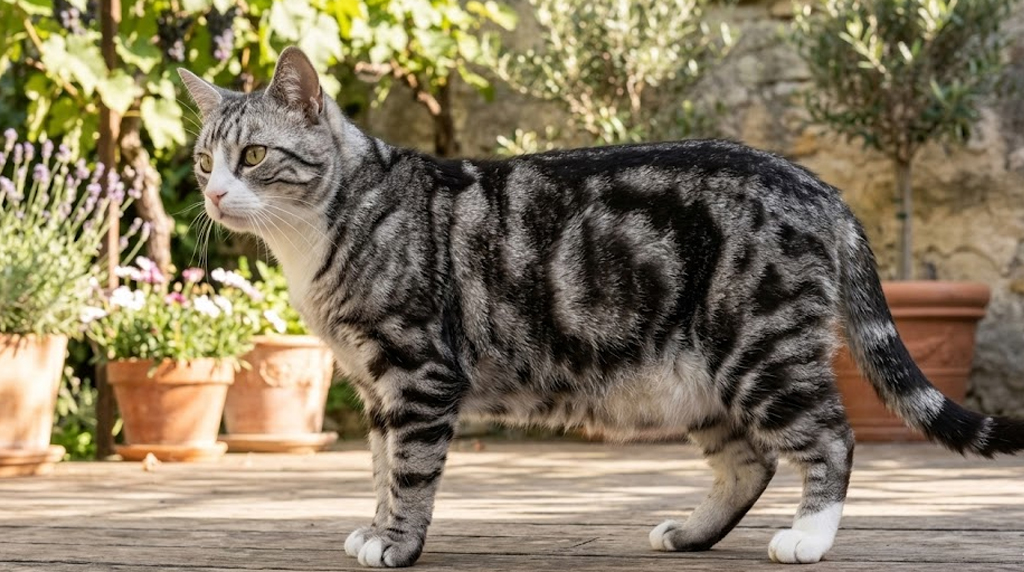
Primordial pouch or overweight: how to tell them apart
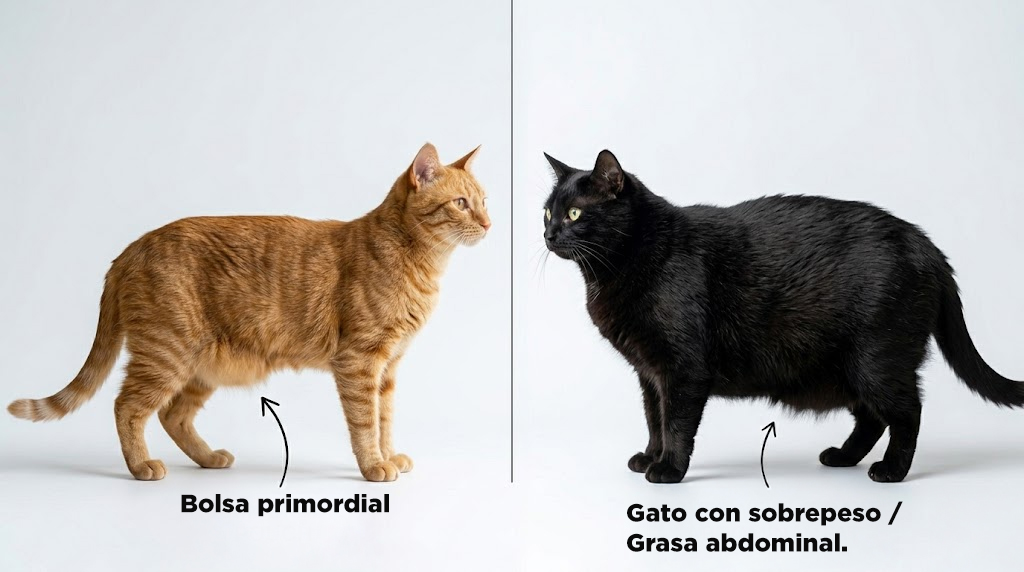
Here is the key point of the article, because it is the real doubt driving the search. The primordial pouch is not equivalent to fatness. Vitakraft explains that in an obese cat, fat is distributed across different areas of the body and is not as localized or swaying as in the primordial pouch. AniCura adds that the evaluation of overweight should be done by feeling the ribs and observing the general silhouette, not just looking at the belly. Rover reinforces this idea with the Body Condition Score and a comparison between signs of healthy weight and excess fat.
How it is observed when walking: A normal primordial pouch usually sways or sinks slightly when the cat walks. Many caregivers notice precisely that side-to-side movement. In contrast, excess fat usually looks more fixed and stuck to the body. This observation does not replace a full assessment, but it does help differentiate a normal anatomy from a rounder belly due to overweight.
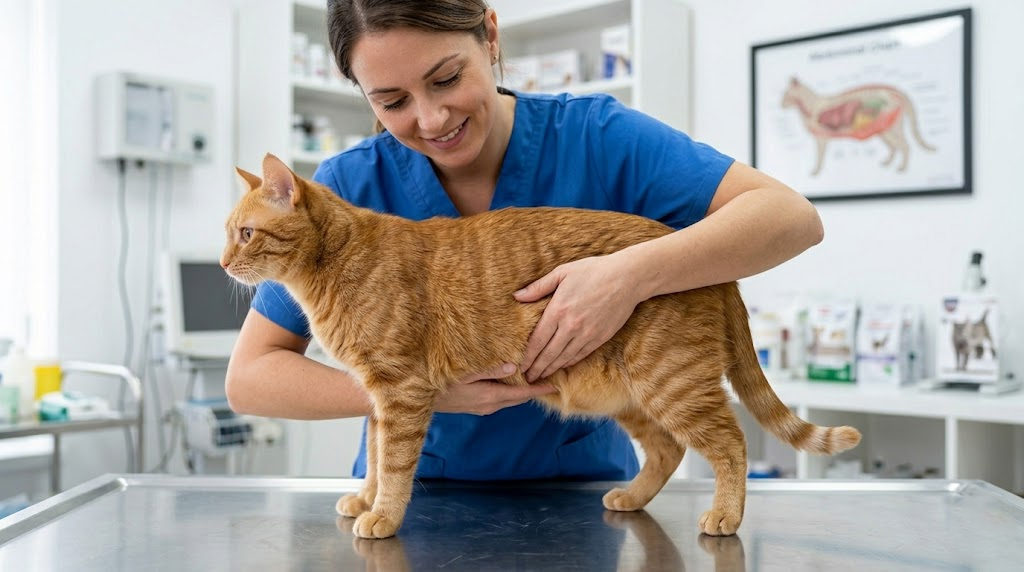
How it feels to the touch: When touching the area, the primordial pouch usually feels soft and loose, not like a compact block of fat. This perception matches the practical explanation the user was looking for: it doesn't feel like a hard or uniform abdomen, but like more mobile skin and tissue.
What signs point to feline obesity: Obesity is best assessed by observing the body as a whole. Rover and AniCura agree on looking at whether the waist remains visible from above and if the ribs can be felt under a thin layer of fat. When the cat loses that shape and it is hard to feel the ribs, the problem is no longer a simple primordial pouch.
Does neutering cause the primordial pouch to appear?
No. Vitakraft says it explicitly: although the pouch usually becomes visible at a stage similar to when many cats are neutered, it does not appear because of the neutering itself. Rover adds that the procedure does not create the pouch, although subsequent weight gain can make it more evident.
This is one of the most repeated confusions and should be cleared up with clarity. Neutering can modify metabolism and favor weight gain if diet and activity are not adjusted, but that does not mean it generates a new anatomical structure. What often happens is that the caregiver begins to notice the belly after the procedure or that the area becomes more noticeable due to general body changes.
When the primordial pouch is normal and when it is advisable to see a vet
In most cases, the primordial pouch is completely normal. It is expected to hang, move, and cause no pain. The problem arises when that area changes suddenly or shows signs that do not fit with a typical anatomy. Vitakraft recommends seeing a veterinarian if a lump is noticed in or near that area, and Rover insists on not adopting a "wait and see" attitude if an abnormal mass appears.
It is advisable to request a check-up if:
- a hard or localized lump appears,
- the area is painful to the touch,
- there is redness or inflammation,
- the cat shows discomfort, apathy, or loss of appetite,
- the shape of the abdomen changes abruptly.
AniCura also highlights that many consultations come from fear of a hernia or tumor, and precisely for that reason any strange change is worth checking.
Frequently asked questions about the primordial pouch in cats
Do all cats have a primordial pouch?
The safest explanation is that it is part of feline anatomy, although it is not always noticed equally. Rover presents it as a feature present in all domestic cats, while AniCura points out that it is not seen with the same clarity in all of them.
Can it be eliminated with diet?
Not as such. Rover explains that losing weight can make the belly look different in an obese cat, but it doesn't make the primordial pouch disappear because it is not simply "excess fat."
Does the primordial pouch indicate the cat is healthy?
Not necessarily. Its presence can be normal, but it does not serve as a seal of good health. What matters is the cat's full body condition, its mobility, its appetite, and the absence of anomalous signs.
The primordial pouch in cats is a normal abdominal structure that often causes alarm only because it is easily confused with overweight. Understanding what it is, how it moves, what functions are attributed to it, and how it differs from obesity helps to observe the cat with much more insight. The key is not to judge that "little belly" in isolation: you must observe the entire body, the waist, the ribs, and any sudden changes. If the area simply hangs and sways, it is most likely a normal primordial pouch. If a hard lump, pain, or inflammation appears, then it is advisable to see a veterinarian.
Leave a Reply Cancel Reply