




Which is the world's largest dog? (By height and by weight)
If you are looking for "which is the world's largest dog," here is a heads-up: there are two correct answers, because "largest" can mean tallest or heaviest. If this is not clarified, the usual happens: one person says "Great Dane" and another says "English Mastiff"... and both are technically right in their own way.
When preparing a ranking (including characteristics, temperament, and care), it is ideal to always separate it into two leagues: the tall ones (height at the withers) and the "tanks" (weight). From there, everything fits into place.
Quick answer: "Largest" can mean two things
Tallest: Height at the withers (the "official" measurement)
Height at the withers is the "serious" measurement when talking about records and comparisons: from the ground to the highest part of the back (between the shoulder blades). It is the most consistent way to compare dogs, because measuring "on two legs" can vary greatly depending on posture, training, or how excited the dog is that day.
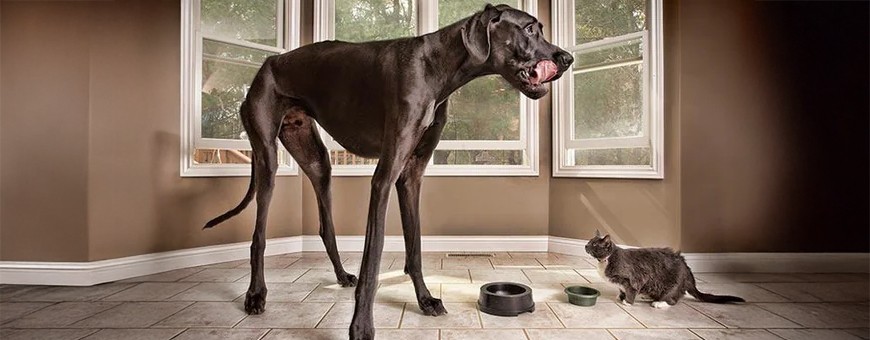
The most famous case is Zeus, a Great Dane, measuring 111.8 cm at the shoulder (height at the withers) and over 2.20 m standing up. The key here is the first figure: 111.8 cm. Standing on two legs is impressive (and helps to visualize it), but it is not the standard measurement for comparison. Taking him for a walk must have looked more like a parade than a stroll; with a giant like that, you don't walk him: you parade with an escort.
Heaviest: The king of weight is not always the tallest
By weight, the conversation changes. The English Mastiff appears as one of the heaviest, potentially reaching around 100 kg for large males (and some individuals go even higher, though it is not ideal or healthiest). Here, "largest" means "more mass," but beware: more weight does not mean better, healthier, or easier to handle.
In fact, in giant breeds, weight must be treated as a health issue: joints, heart, and especially the risk of gastric torsion (bloat) if food and activity are not managed properly.
The world's largest dog according to height records: Why the Great Dane usually wins
In the height league, the Great Dane (German Mastiff) is usually the protagonist. It is defined as the "Apollo of dogs": elegant, tall, with the presence of a "model" (but in XXL). The truth is that when the question is "which is the largest?", the public almost always refers to height, as it is what impacts at first glance.
Key measurements and how it is measured
- Height at the withers: The most reliable comparative measurement.
- "On two legs": Spectacular for imagining size, but not the basis for serious rankings.
- Zeus (Great Dane): The most cited case at 111.8 cm at the withers. To put it in context: a normal Great Dane can already exceed 80 cm; when you go over 1.10 m, you are in "educated horse" territory.
Temperament: Noble giant (with proper training)
Highlighting the character: friendly, not very territorial, noble. It is a breed that, well-bred, usually fits in with families... but let's be clear: a "kind" dog weighing 70–90 kg is still a massive animal. If it pulls the leash, the leash rules. If it sits on your foot, it changes the shape of your foot.
Size isn't scary... what is scary is the lack of routine (proper walks, basic training, and veterinary check-ups). There is a predisposition to joint problems; that is a central theme.
The largest breed by weight: The English Mastiff and "tank mode"
If the question is "which is the largest by weight?", the list makes it very clear: the English Mastiff is among the most impressive in terms of mass. Here the type of "large" changes: it’s not a dog that looks tall and slender; it’s a dog that looks like a wall with legs.
Realistic weight and what to expect at home
Mentioning that they can reach 100 kg means, in real life:
- Eating "a lot"? No... eating seriously.
- XXL bed (and not just one, because they will move it).
- Car with a large trunk or foldable seats.
- And a floor that isn't like ice skating (because slipping with that weight is a recipe for injury).
Key care: Diet and gastric torsion
"Strictly controlled diet to protect joints and avoid gastric torsion." That line should be in neon. To break this down:
- Portioned meals (not one big binge).
- No intense exercise right before or after eating.
- Watch for strange symptoms (restlessness, retching without vomiting, swollen belly) and see a vet immediately if suspected. With giants, prevention is the superpower.
Top 10 giant dog breeds (Character + Care) and which one fits you
Ordered for a quick overview: family giants, guardians, and athletic giants. (Because a "cuddly bear" is not the same as a "territorial guardian".)
Family giants (the "gentle giants")
- Newfoundland: Defined as a "nanny dog," with webbed feet and a talent for water rescue. Key: frequent brushing + swimming if possible.
- Leonberger: "Gentle giant," patient and affectionate. Key: thick coat; minimum weekly brushing.
- Saint Bernard: Iconic, calm; can reach up to 120 kg. Key: drool + hip dysplasia (and watch the heat).
- Great Dane: Elegant, sociable, and prone to joint issues.
In "street terms": these are the dogs people fall in love with because they are good-natured + sofa-sized. With a Saint Bernard or a Newfoundland, people will definitely stop you on the street.
Guardians (Protection and territory)
- Tibetan Mastiff: Independent, protective, territorial; does not tolerate heat well.
- Neapolitan Mastiff: Wrinkles, weight, guardian by instinct; fold hygiene is essential.
- Dogue de Bordeaux: Robust, protective with children; wrinkle cleaning.
- Pyrenean Mountain Dog: Brave, intelligent, sociable; needs space and activity.
Clear recommendation: if someone wants a "giant dog" for aesthetics but doesn't want to manage territoriality or guardian instincts, it's better to go with the gentle ones.
Athletic giants (Elegant and fast)
- Borzoi (Russian Wolfhound): Tall, elegant, fast; reserved and calm. Long coat: weekly brushing.
Quick Table: Height vs. Weight (to settle the debate)
| Category | "Typical Winners" | What impresses | What to watch |
|---|---|---|---|
| Tallest (height at withers) | Great Dane (Zeus) | Look like "fine horses" | Joints, growth, check-ups |
| Heaviest (mass) | English Mastiff, Saint Bernard | "Tanks" that fill the house | Diet, joints, gastric torsion |
| Family and patient | Newfoundland, Leonberger, St. Bernard | "Zen" character | Coat, heat, dysplasia |
| Guardian and territorial | Tibetan/Neapolitan Mastiff, Dogue de Bordeaux | Presence + protection | Socialization, folds/hygiene, heat |
| Athletic giant | Borzoi | Elegance + speed | Coat, sensitivity, gentle training |
Practical guide before living with a giant dog (what no one tells you)
A realistic checklist, because most articles just say "they are big and adorable" and that's it.
- Space: You don't need a mansion, but you do need obstacle-free hallways and an area where the dog can stretch out. A giant lives "wide."
- Training is a must: With 10–20 kg you can wing it; with 70–100 kg, winging it is a high-risk sport. Leash, recall, stay, and handling.
- Heat: Many breeds (Tibetan, Saint Bernard, furry giants) handle it poorly. Shade, cool schedules, water.
- Health: The usual suspects appear: dysplasia, joints, gastric torsion. This isn't a "maybe": it's a "probability."
- Coat and drool: Newfoundland, Leonberger, Pyrenean... the brush is not an accessory, it's a religion. And with a Saint Bernard... drool is part of the pack.
- Cost: XXL bed, XXL carrier/harness, more food, and a vet who understands large breeds.
A friendly truth: when someone says "I want the world's largest dog," they often actually want a balanced and healthy giant, not "the tallest" at any cost. That's where you choose with your head.
FAQs about the world's largest dog
What is the world's largest dog?
It depends: by height, the Great Dane is usually cited (Zeus at 111.8 cm at the withers). By weight, the English Mastiff is usually on top.
Is "largest" the same as "tallest"?
No. "Tallest" = height at the withers. "Largest" can be height or weight.
Which is the best giant breed for families?
Newfoundland and Leonberger stand out for patience and affection; Saint Bernard too, though with more drool and higher joint risk.
Can giant dogs live in an apartment?
They can, if there is a routine, proper walks, and the dog is calm. But you need logistics: space to move, an elevator or good stair management, and solid training.
What is the most serious health problem?
In giants, two things constantly appear: joints/dysplasia and gastric torsion (especially in large breeds with deep chests). Prevention changes the game.
Leave a Reply Cancel Reply