





Cushing's Syndrome in Dogs
It is a disease caused by an excess of cortisol in the blood. From that starting point, many things become clear. We are not just talking about a dog that drinks more water or has a belly more swollen than usual, but a hormonal disorder that can affect metabolism, skin, muscles, and several organs at the same time.
Many people initially think their dog is simply “getting old,” that they are weaker, have gained weight around the belly, or are asking for more food just because. But it isn't always age. In many cases, behind these changes lies a sustained increase in cortisol that is altering the body's normal functioning.
Furthermore, it is a disease that generates many real questions: if there is a cure, how long a dog with Cushing's can live, what symptoms appear at first, or what treatment the veterinarian usually prescribes. In this case, one of the most useful ways to explain it simply is to focus on the signs the owner sees at home: drinking a lot, urinating a lot, increased hunger, hair loss, thinning skin, and the appearance of that typical rounded belly. With that foundation, everything else becomes easier to understand.
What is Cushing's Syndrome in Dogs
Cushing's syndrome, also called canine hyperadrenocorticism or hypercortisolism, occurs when the body produces or maintains too much cortisol for too long. Cortisol is a necessary hormone; it is not “bad” in itself. In fact, it helps respond to stress, regulates part of the metabolism, and participates in multiple body functions. The problem begins when its levels skyrocket or remain chronically elevated.
This excess cortisol can originate in two main places. One is the pituitary gland, a gland located in the brain that regulates other hormones. The other is the adrenal glands, which are located on top of the kidneys and are responsible for producing cortisol. In many cases, the origin is related to a tumor, which can be pituitary or adrenal. There is also iatrogenic Cushing's, which appears when a dog receives corticosteroids for a long time and the treatment itself alters the hormonal balance.
It is important to understand that this is not just an abstract “hormone problem.” The excess cortisol gradually leaves its mark on the dog's body. Therefore, it can affect muscle mass, fat distribution, appetite, skin, hair, and even increase the risk of other complications. When explaining this topic simply, it seems key to insist on this: it is not a single isolated sign, but a set of changes that fit together.
It should also be noted that it is a disease much more frequent in dogs than in cats. And, although the diagnosis must always be made by a veterinarian, knowing well what Cushing's is helps greatly in not normalizing symptoms that should not go unnoticed.
Symptoms of Cushing's in Dogs: How to Detect it in Time
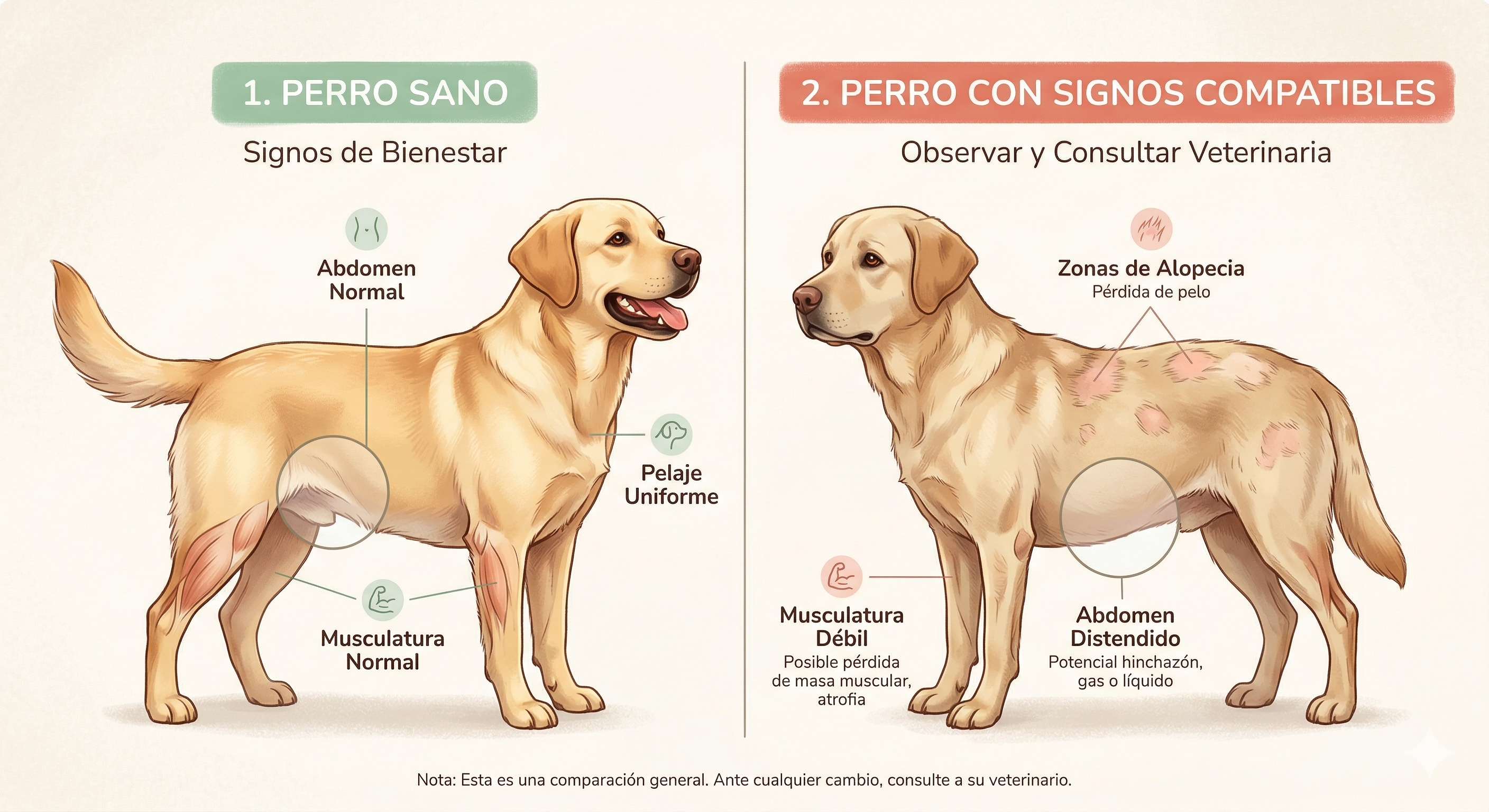
This is where the real work happens, because Cushing's symptoms are usually the reason why an owner begins to suspect that something is wrong. And curiously, the pattern is often quite recognizable. In this way of explaining it, the most typical warning signs are: the dog urinates in large quantities, drinks a lot of water, has a voracious appetite, loses hair in certain areas, shows thin skin, has a noticeably swollen belly or distended abdomen, and may also show muscle weakness.
Put that way, it seems like a long list, but in reality, several of these signs usually present together. One of the first changes many people detect is that the water bowl empties sooner than usual. Then comes the increase in urination, with more outings, more accidents at home, or more need to pee during the night. That combination of polydipsia and polyuria is one of the most classic clues.
Then there is the issue of hunger. A dog with Cushing's can become very insistent with food, asking for more, scavenging for scraps, or appearing never to be full. Added to this are visible physical changes: the belly rounds out, the hair falls out or becomes sparse, the skin feels more delicate, and the animal seems to lose muscle tone. Occasionally, the owner describes something very specific and graphic: “my dog has more of a belly, but feels weaker.” That phrase sums up quite well what can happen.
Another important point is that some symptoms are confused with normal aging. An older dog may be less active, yes, but it is not normal for them to suddenly drink excessively, urinate exaggeratedly, or develop such marked changes in skin and abdomen. That’s why it’s worth paying attention. Detecting it early doesn't always mean solving it immediately, but it can make a huge difference in disease management and quality of life.
What Happens to a Dog with Cushing's if it is Left Untreated
When Cushing's is not detected or well-controlled, the excess cortisol continues to take its toll. And here it should be made clear that we are not just talking about annoying or striking symptoms, but also about consequences that can significantly complicate the situation. One of the ideas that makes the most sense to repeat is that this hormonal disorder can end up affecting different organs and opening the door to additional problems.
Among the most mentioned complications are diabetes, pancreatitis, hypertension, and skin or urinary tract infections. This fits perfectly with the logic of Cushing's: if the body has been functioning with high cortisol for a long time, the metabolism changes, the immune system may respond worse, and imbalances appear that should not be underestimated. Sometimes the owner arrives concerned about hair loss or a swollen belly, but the real risk lies in everything that can develop behind the scenes.
Muscle weakness can also worsen, apathy can increase, and the dog's general quality of life can deteriorate. Some animals continue to eat heartily but move worse and worse, rest more, pant easily, or have recurring skin and ear problems. That pattern of “high appetite but worsening general condition” is also a warning sign.
In the experience of organizing this type of information, one of the best ways to explain it to the reader is this: Cushing's doesn't always start as an emergency, but it can become a serious problem if allowed to progress. Therefore, when a dog exhibits several typical symptoms, the sensible thing is not to wait to “see if it passes,” but to consult with a veterinarian and clear up any doubts with tests.
How Cushing's Syndrome is Diagnosed in Dogs
The diagnosis of Cushing's syndrome in dogs is not made just by looking at symptoms. Clinical signs are very helpful guides, but they are not enough on their own. The veterinarian usually combines the medical history, physical examination, and several tests to confirm if there really is hyperadrenocorticismo and, when possible, to narrow down its origin.
A clear way to summarize it is to say that the diagnosis usually includes blood work, ultrasound, and specific tests to measure or assess cortisol. This simple explanation is very useful because it gives the owner a realistic idea of what comes after the suspicion. It is usually not just one "magic" test, but a process.
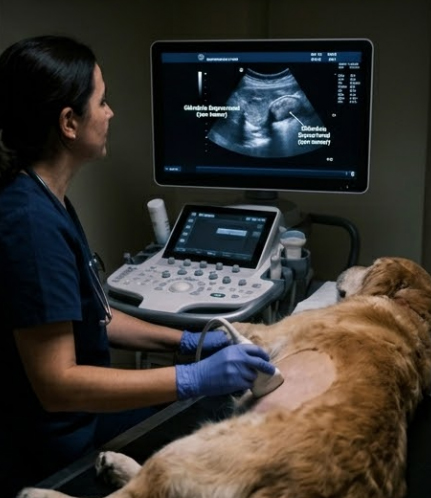
Blood and urine tests serve to detect alterations compatible with Cushing's and to assess the dog's general condition. Afterwards, an abdominal ultrasound can help check the appearance of the adrenal glands and look for clues as to whether one or both are affected. Then there are hormonal tests, which allow for more precision. Among the best known are the ACTH stimulation test and the dexamethasone suppression test.
Simply put: these tests help see how the dog's body responds to certain hormonal stimuli or suppressants. There is no need for excessive technicality for the reader to understand. What is truly important is to convey that the veterinarian is not asking for tests “just because,” but because Cushing's can look like other problems and must be properly confirmed before treating.
It is also worth saying something that sometimes reassures: the diagnosis may require some patience. It is not always resolved in the first visit. But precisely because it is a complex disease, doing the diagnosis correctly is what allows for selecting the best treatment and monitoring progress more safely.
Treatment for Cushing's in Dogs
Treatment depends on the type of Cushing's, the dog's general condition, and what the veterinarian determines after testing. In many cases, the most common option is oral medication, especially when seeking to control the excessive production of cortisol over time. This generally consists of pills, although not all cases are the same and not everything is resolved in the same way.
One of the goals of treatment is to reduce symptoms and improve quality of life. The dog should gradually stabilize: drinking less, urinating less, regaining some energy, and stopping some of the physical changes. But we must be realistic: it is not usually a “one pill and it’s fixed” disease. Veterinary follow-up, periodic reviews, and adjustments according to the animal's response are normal.
In certain cases, especially when there is a specific adrenal tumor, surgery may be considered. This is not the most frequent situation for all dogs, but it is a possibility worth mentioning because it answers a common user question: whether it is always treated with medication or if surgery is ever an option. The correct answer is that it depends on the origin of the problem and veterinary judgment.
Another important part of the treatment is long-term control. A dog with Cushing's needs monitoring to ensure that cortisol is better regulated and that no unwanted effects appear. This follow-up is not a secondary detail; it is part of the treatment. In fact, it often makes the difference between a dog that is simply “taking something” and one that is truly well-controlled.

How Long Does a Dog with Cushing's Live
This is one of the most searched questions and also one of the most delicate, because it cannot be answered with a universal figure. The life expectancy of a dog with Cushing's depends on several factors: the type of Cushing's, the time it is detected, whether there are associated complications, the response to treatment, and the age of the animal.
What can be said honestly is that many dogs can maintain a good quality of life for a long time if the diagnosis comes early and the treatment is well-adjusted. That is the important idea. We shouldn't sell a false sense of security, but neither should we present it as an immediate sentence. In many cases, the problem becomes a controllable chronic disease, not a terminal emergency.
When the disorder is identified late or there are already complications such as diabetes, pancreatitis, hypertension, or recurrent infections, the prognosis can worsen. That is why insisting so much on the symptoms is not alarmism: it is prevention. The sooner it is suspected and confirmed, the more room there is to act effectively.
It seems especially useful to explain it this way: the prognosis doesn't just depend on “having Cushing's,” but on how advanced it is, what causes it, and how that specific dog responds to treatment. Some animals improve greatly when they stabilize, regain part of their routine, and are comfortable again. Others require more adjustments and more vigilance. The key is not to reduce the conversation to a number, but to quality of life and correct management.
Diet and Care for a Dog with Cushing's
Diet does not replace treatment, but it is part of overall care. A dog with Cushing's needs a routine that is as stable as possible, weight control, daily observation, and veterinary follow-up. When the disease is active, it is a good idea to monitor appetite, water consumption, urination frequency, skin condition, and any changes in energy or behavior.
Since many dogs with Cushing's are hungrier, one of the real difficulties at home is managing that food anxiety without resorting to constant treats or poorly adjusted rations. Here it matters a lot to maintain a consistent pattern and not improvise. If there are also other complications, such as a tendency toward diabetes or pancreatitis, the diet may need more specific adjustments as indicated by the veterinarian.
It is also worth paying attention to the skin and hair. Since the skin can become thinner and more fragile, it is advisable to avoid unnecessary irritation, check for infections, and consult quickly if redness, foul odor, itching, or lesions appear. The same applies to urinary infections: if the dog changes its urination pattern, licks itself more, or seems uncomfortable, it should be mentioned.
At home, the most useful care is usually the most constant: medication at the scheduled time, check-ups when due, daily observation, and zero normalization of symptoms because “they are old.” That idea sums up very well how to live with a dog with Cushing's: less drama and more control over the details that truly matter.
Frequently Asked Questions about Cushing's Syndrome in Dogs
What symptoms does a dog with Cushing's have?
The most typical ones are drinking a lot of water, urinating a lot, eating with more anxiety, having a swollen belly, hair loss, thin skin, and muscle weakness. They do not always appear all at once, but when several occur together, it is advisable to consult a veterinarian.
What happens if a dog has Cushing's disease?
Excess cortisol alters metabolism and can affect several organs. Without control, it can favor complications such as diabetes, pancreatitis, hypertension, and skin or urinary infections.
How does Cushing's syndrome begin?
It often begins gradually. The owner usually first notices that the dog drinks more, pees more, and is hungrier. Later, physical changes such as a distended abdomen, hair loss, or weakness may appear.
Is Cushing's syndrome curable?
It depends on the type and cause. Some cases may require surgery, but it is more common to speak of a disease that is managed rather than a simple and immediate cure. The veterinarian is the one who can guide this based on the diagnosis.
How long does a dog with Cushing's live?
There is no fixed number. The prognosis depends on the type of Cushing's, the time of diagnosis, complications, and response to treatment. With good control, many dogs can maintain a good quality of life for a long time.
What foods should a dog with Cushing's not eat?
There is no universal list valid for all dogs, as it depends on their general condition and associated diseases. The most prudent thing is to avoid improvising with treats and excess calories, and to follow the veterinarian's guidelines if there are problems like overweight, pancreatitis, or diabetes.
Cushing's syndrome in dogs is a serious hormonal disease, but not impossible to manage. The key is recognizing the signals in time, confirming the diagnosis with tests, and following a controlled treatment. If there is one thing worth remembering, it is this: a dog that drinks a lot, urinates a lot, is hungrier, loses hair, and develops a swollen belly should not be dismissed with a simple “it’s just old age.” Sometimes the body is warning of an excess of cortisol that needs veterinary attention.
A useful article on Cushing's should not be limited to defining the disease. It must help the owner understand what they are seeing at home, why it happens, what tests may be requested, and what reasonable expectations they can have for the treatment. And that is exactly the difference between correct content and content that truly meets the search intent.
Leave a Reply Cancel Reply